
Deposit Limits vs. Self-Exclusion: How Each One Actually Works
§ 26.12 · Marc-André Fortin ·

A deposit limit caps how much money an account can take in over a set period. It leaves the account open and allows any balance already in it to be wagered. Self-exclusion is the tool that closes the account entirely, and the two get folded together in marketing copy far more often than the mechanics justify. In Québec, where Loto-Québec holds the online monopoly and the RACJ writes the rules, the gap between the two is visible in the account settings themselves. Deposit limits regulate incoming transfers. Self-exclusion blocks the account and terminates all access.
What a deposit limit actually locks
A deposit limit is a ceiling on incoming money. Set it at $200 a week and the account will accept $200 in a seven-day window, then refuse further deposits until the window rolls over. That is the whole of the promise.
Players often miss what deposit limits leave open. The account stays live. Any balance already in it can be wagered, and winnings from that balance can be re-wagered without a new deposit. A player who deposits $200 on Monday, runs it to $600 by Wednesday, and loses the lot has never breached the limit. The limit tracked the $200 coming in. It placed no restrictions on the $600 moving around inside the account.
This distinction reflects the design. A deposit limit is a cash-flow control, and cash-flow controls do not govern what happens after the cash is in the account.
Deposit limits address concerns about the size of individual deposits. They provide little relief for players whose main problem is the speed at which money moves through active play.
Lowering a limit is instant. Raising it is not.
The asymmetry between these two directions determines whether a deposit limit is useful or merely decorative.
Decreasing a limit takes effect immediately. A player who drops their weekly ceiling from $500 to $100 on a Tuesday has a $100 ceiling from that moment. No waiting period, no support call, no confirmation loop beyond the account settings themselves.
Increasing a limit carries a mandatory cooling-off delay. Ontario’s AGCO Registrar’s Standards for Internet Gaming document this requirement explicitly. A request to relax or eliminate a limit is implemented only after a cooling-off period of at least 24 hours, ensuring that the decision to loosen a limit cannot be made in the same sitting as the urge to deposit more.
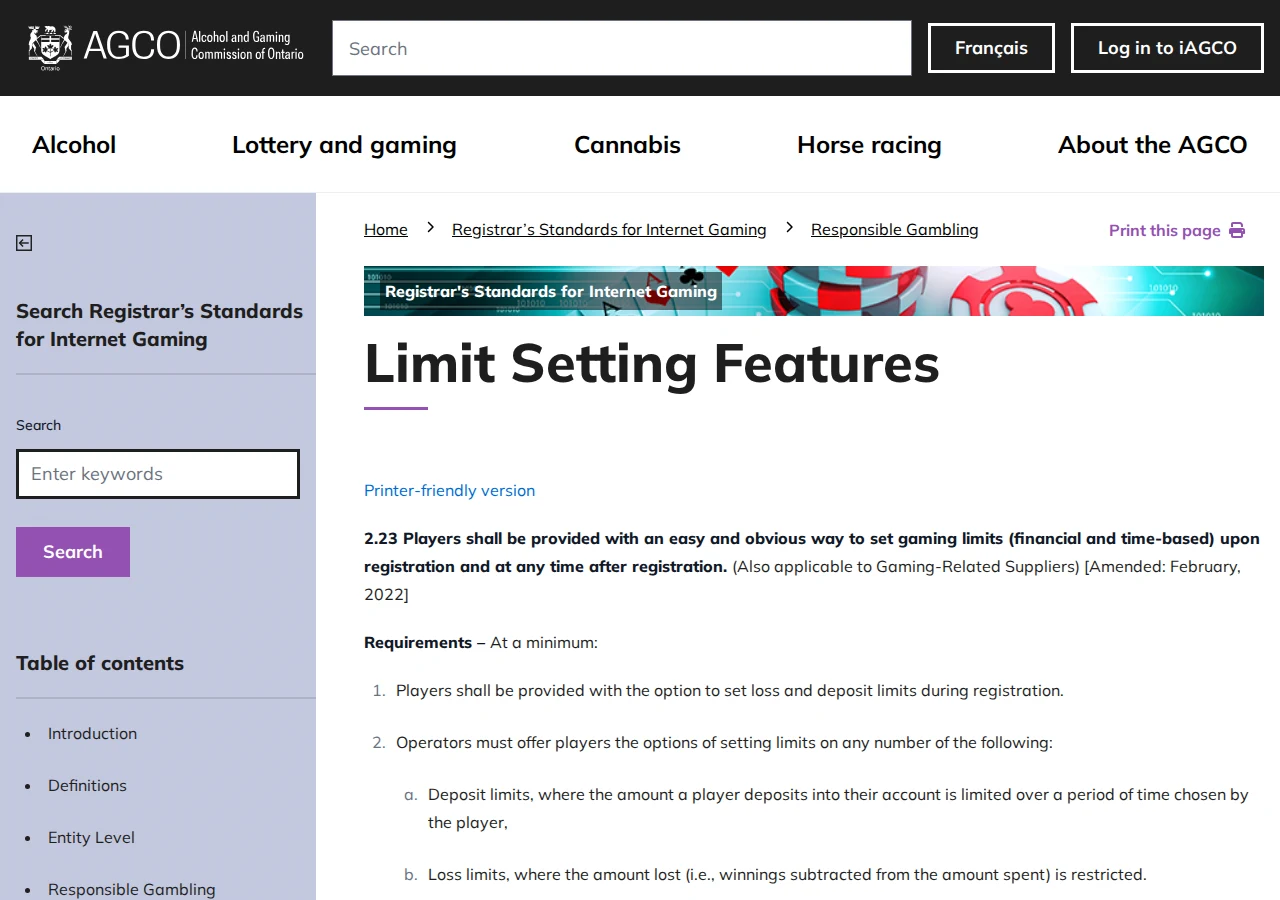
Espacejeux’s own account help pages do not spell out a matching hour count for its increase delay. No Québec-specific cooling-off figure is published there, and none should be assumed. The AGCO standard is cited here as the clearest documented version of the same mechanic; Québec’s actual timeline may differ from Ontario’s published schedule.
The asymmetry is deliberate. Players can tighten a limit instantly when concern arises. Any request to loosen a limit must survive a cooling-off period before activation.
Where deposit limits sit in the Québec system
Québec’s online gambling runs through Loto-Québec, and the regulator behind it is the RACJ. Espacejeux is the Loto-Québec platform most players will meet, and its account-opening flow requires a weekly deposit limit to be set before play begins. The limit is mandatory and integrated into the account-opening process.
One documented ceiling sits on top of that. Espacejeux’s deposit settings page lists a $500-per-week cap on Argent Web prepaid tickets. The platform sets this figure; the player has no control over it. It applies only to the ticket channel, leaving card and bank deposits outside its reach.
Québec players thus operate within multiple limits by default. The weekly limit they select at sign-up remains under their control. The Argent Web $500 cap operates as a platform-level constraint regardless of individual settings.
These limits sit in the same settings menu alongside self-exclusion options, which is where the confusion between tools begins.
Changing a limit at Espacejeux, in practice
The weekly deposit limit is set in the account’s deposit/limit settings on lotoquebec.com, in the Espacejeux my-account/deposit section. That is the same field a player returns to when they want the number changed.
Lowering the limit applies immediately, as described earlier. A player who moves the weekly figure down sees the new ceiling govern the account from that moment.
Raising the limit is submitted through the same account settings. Espacejeux’s own help pages do not publish an hour-count for how long that request takes to clear, and no figure should be read into the gap where one is not stated. What the earlier AGCO comparison establishes is the pattern behind that gap: an increase triggers a mandatory review period before the account applies the new figure.

The Argent Web $500-per-week cap operates alongside the player’s own chosen weekly limit, with the lower figure governing that channel. Players with personal limits above $500 face the platform-imposed $500 ceiling on Argent Web deposits. Players with personal limits below $500 never encounter the product cap, since their own chosen limit applies first. In all cases, the tighter restriction applies.
None of this changes what the account can do once money is inside it. A lowered limit, a raised limit, and the Argent Web cap all govern incoming deposits. Play on an existing balance, and re-wagering of winnings from that balance, remain outside their reach. Closing the account is self-exclusion’s function, and it is not something a deposit-limit setting performs at any value.
What self-exclusion does that a deposit limit cannot
Self-exclusion blocks the account entirely.
Québec runs a formal self-exclusion program separate from any deposit-limit setting. The available terms run from three months to five years. Enrolment happens through Manage My Gambling or through Customer Care. Once enrolled, the exclusion is irrevocable for the term chosen, the account is blocked, and any balance sitting in it is refunded.
The refund detail shows the difference clearly. Deposit limits leave the account balance in place while allowing active play to continue. Self-exclusion returns the entire balance to the player and terminates all access. Deposit limits regulate incoming transfers while the account remains active. Self-exclusion closes the account permanently and refunds the standing balance.
The irrevocability is load-bearing. Deposit limits may be raised after a cooling-off period. Self-exclusion terms are not shortened by request—a three-month selection is binding for the full three months.
Self-exclusion suits players who require a complete account closure. Enrollment is unnecessary for players seeking only a spending ceiling while maintaining account access, and joining the self-exclusion program to address budgeting concerns means surrendering the continued access that deposit limits preserve.
The RACJ’s role in setting these rules
The RACJ regulates gambling in Québec and oversees the Loto-Québec monopoly over online play. Deposit-limit rules, self-exclusion terms, and the Argent Web cap all sit inside that framework, and Loto-Québec is currently the only operator authorized to run legal online gambling in the province through Espacejeux and Mise-o-jeu.
Moving from a deposit limit to real self-exclusion
The two tools live in different parts of the account, and many players set a limit believing they have done the harder thing.
A player who wants a hard stop does not raise their deposit limit, lower it to zero, or delete their saved payment method. Those are all still deposit-side moves on an account that remains open. The step that closes the account is enrolment in the self-exclusion program, through Manage My Gambling or Customer Care, for a term between three months and five years.
Before enrolling, check two things. First, whether any balance is sitting in the account, since enrolling triggers a refund of it. Second, whether the chosen term is the one they actually want, because it cannot be shortened once it starts.
Players who seek only reduced spending and believe an open account poses no inherent risk benefit from a low deposit limit maintained consistently. Players desiring account closure for a fixed period gain nothing from any deposit-limit setting. The choice between tools is not a matter of degree but of intent and outcome.
The wider set of player-protection tools, including the ones that sit between these two, is covered in the site’s walkthrough of responsible gambling tools.
Why the two get conflated
Deposit limits and self-exclusion appear in the same settings menu, are described in the same responsible-gambling language, and are often listed as adjacent options. That adjacency does considerable work in making them feel interchangeable.
They serve fundamentally different purposes. A deposit limit is a number the account will not exceed on incoming money. Self-exclusion is a period during which the account does not exist for the player.
Players who know whether their problem is spending too much per top-up or needing the account gone can select the matching tool. Those who assume the two are variations of the same thing will set a deposit limit, feel protected, and continue playing on a balance the limit never governed.

Bylaw Desk — editorial byline