
Payment Options Preferred by Canadian Casino Players
§ 25.16 · Marc-André Fortin ·

Interac e-Transfer remains the default deposit method for Canadian casino players because it moves money bank-to-bank with no card number or wallet middleman. E-wallets and cryptocurrency are the fastest-growing alternatives. Online transfers as a category grew 175% in transaction volume between 2020 and 2024, the fastest of any Canadian payment method, according to Payments Canada. Each method has a different profile for funding your account and cashing out.
Interac Still Leads Canadian Casino Deposits
When you play at a regulated Canadian casino online, Interac e-Transfer is the method most sites list first. You authorize each transfer from your own online banking session, so you never hand your card details or bank account number to the casino itself.
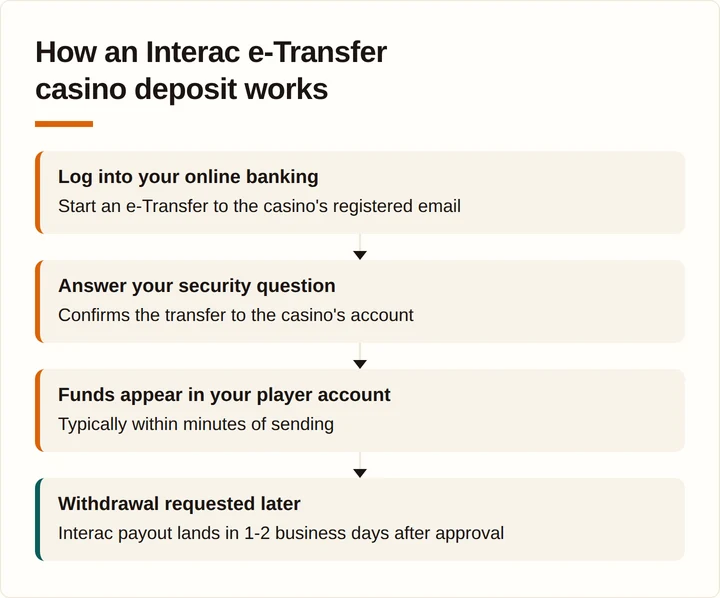
Payments Canada’s data on national payment trends shows online transfers were the fastest-growing payment method between 2020 and 2024. Transaction volume rose 175% over that five-year span, while transaction value climbed 219%. Online transfers now account for about 7% of total Canadian payment volume across all retail activity. That national trend tracks what you will see at the cashier page of most Canadian-facing casinos. The deposit flow takes about two minutes. You log into your bank, send an e-Transfer to the casino’s registered email address, answer the security question you set, and the funds typically appear in your player account within minutes.
Not every casino accepts Interac for withdrawals. Some sites let you deposit by e-Transfer and require you to withdraw by bank wire or e-wallet. Check the cashier page before you commit to a site if you want your winnings to return through the same channel.
E-Wallets Close the Speed Gap
PayPal, Skrill, and Neteller remain popular with Canadian players who want faster withdrawal cycles. E-wallets add an extra step between your bank and the casino, and they compress the time your winnings sit in limbo.
Deposits through e-wallets are instant in nearly all cases. The casino receives a notification from the wallet provider and credits your account immediately. You fund the e-wallet from your bank account beforehand, which takes a day or two, and once the balance is there, transactions clear in seconds. Withdrawals are where e-wallets earn their keep. Most casinos process e-wallet cashouts within that same window, and the money lands in your wallet immediately after approval. From there you transfer to your bank account, which adds another business day. Direct bank transfers typically take three to five business days from request to arrival.
The Statista digital payments landscape data confirms e-wallets as a permanent fixture in Canadian payment habits. E-wallets have kept a steady share of Canadian online transactions.
Credit and Debit Cards Stay Relevant, Slower on Withdrawals
Visa and Mastercard remain accepted at most Canadian casino sites, and they are the fallback option when you do not want to set up an e-wallet or use Interac. Deposits process instantly, and you earn whatever rewards your card offers on everyday spending.
The friction comes at withdrawal time. Card networks treat gambling transactions as higher-risk, so many casinos cannot push funds back to a credit card at all. Debit cards attached to Canadian bank accounts work more often, and the processing time stretches to three to five business days. Another practical issue is that some Canadian banks block gambling-related card transactions entirely. If your bank declines a casino deposit, the transaction fails at the card network level, and you will need to use Interac or an e-wallet. This is a bank-level policy that the casino does not control.
Cryptocurrency Ownership Is Rising Faster Than Crypto Payments
The gap between owning crypto and actually paying with it shows up clearly in two separate surveys. The Ontario Securities Commission’s Crypto Assets survey was based on fieldwork by Ipsos with 2,360 Canadian adults. That survey found ownership rose to 25%, up from 10% in 2023. Awareness of crypto assets also climbed, to 59% from 54%.
Those numbers describe investment holdings. Payments Canada’s 2025 Trends Report found only 3% of adult Canadians said they had ever used cryptocurrency to send or receive a payment, based on the latest available data. Canadians treat crypto as an asset for investment purposes, with that ownership figure far outpacing actual payment usage.
A handful of sites accept Bitcoin, Ethereum, and a few stablecoins for deposits, and the appeal is privacy and speed. Crypto deposits confirm on the blockchain in minutes, and withdrawals bypass the banking system entirely.
The practical friction is the volatility. If you deposit Bitcoin and the price drops 5% while you play, your bankroll shrinks in Canadian-dollar terms even if you are winning. Stablecoins like USDC or USDT avoid that problem. Fewer casinos accept them.
Alberta’s New Market Brings a Second Regulatory Standard
Alberta launched its regulated online gambling market on July 13, 2026, becoming Canada’s second competitive regulated online market after Ontario. The Alberta Gaming, Liquor and Cannabis Commission (AGLC) oversees the market. More than 50 operators had registered with AGLC by launch. Only a handful were confirmed live on day one.
The AGLC set October 13 as the deadline for operators to either fully launch their Alberta-licensed platform or exit the market. That transition period means some sites you can access today from Alberta are operating under licences from other jurisdictions until their AGLC approval goes live.
Ontario provides the comparison point for how quickly a regulated market matures. Ontario’s online casino revenue kept setting monthly records this year. The most recent monthly figures show a new record in July.
| Month | Revenue | Notes |
| May 2026 | CA$326.4 million | — |
| June 2026 | CA$316.8 million | — |
| July 2026 | CA$330.4 million | new record, up 30.9% YoY from CA$252.4 million (July 2025) |
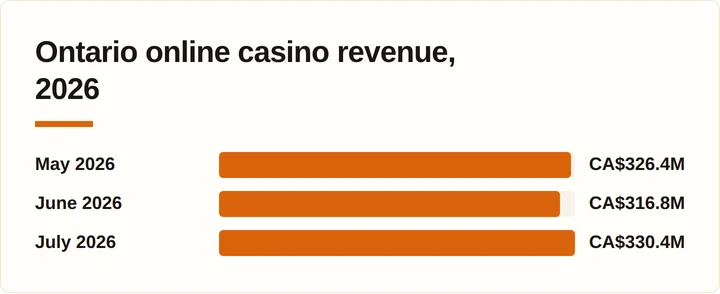
Those figures cover online casino activity specifically. Ontario’s broader iGaming total, which also includes sports betting, is reported separately.
For payment methods, Alberta’s launch means the same regulated-market payment rails that operate in Ontario will apply there. Interac, e-wallets, and cards all function within AGLC’s framework, and the province’s banks have no reason to treat regulated transactions differently from Ontario’s.
Transaction Speed Still Decides Where Canadians Play
When you compare payment methods side by side, speed is the deciding factor for most players. Deposits are fast across every method, so the real differentiator is how quickly you can access your winnings. E-wallets lead on withdrawal speed, with most casinos processing cashouts within that same window. Interac withdrawals, where offered, typically land in your bank account within one to two business days after approval. Bank transfers and card withdrawals trail at three to five business days. The processing time is only half the equation, because the casino’s internal approval step, often called “pending time,” applies before any withdrawal method kicks in. Most regulated Canadian casinos review withdrawal requests within 24 to 48 hours, and that window is identical regardless of whether you chose Interac, PayPal, or Bitcoin. Choose a casino that supports Interac for deposits and an e-wallet for withdrawals if you want the fastest round trip, since that combination gives you bank-level security on the way in and near-instant access to your winnings on the way out.
FAQ
What is the fastest payment method for Canadian casino withdrawals?
E-wallets like PayPal, Skrill, and Neteller are the fastest, with most casinos processing cashouts within a day. Bank transfers take three to five business days.
Does Interac charge fees for casino deposits?
Interac e-Transfers are free at most Canadian banks for standard transfers. Your bank may charge a small fee for premium or instant transfer options. The casino itself does not add a deposit fee.
Why do some Canadian banks block casino transactions?
Banks set their own risk policies, and some decline card transactions they classify as gambling-related. Interac e-Transfers and e-wallet deposits typically bypass these blocks because they do not expose your card number to the merchant.
Is cryptocurrency safe for casino payments?
Ownership of crypto among Canadians has grown to 25%. Only 3% have ever used it to pay for anything. The security risks are volatility and irreversible transactions, not the blockchain itself. Stablecoins reduce the volatility concern. They are accepted at fewer casinos.

Bylaw Desk — editorial byline