
Welcome Bonus Fine Print: 7 Clauses Most Players Skip
§ 26.18 · Marc-André Fortin ·

A welcome bonus is a contract, and the terms page is the contract. The headline number is marketing; the clauses underneath decide what a player actually receives. Most disputes trace back to one of seven lines that were on the page the whole time.
What does a maximum cashout cap actually do?
Bonus winnings are capped at a flat amount or a multiple of the qualifying deposit. A common structure caps total withdrawable bonus winnings at 4x the qualifying deposit, regardless of how large the balance grew during play.
A player deposits $100, receives a match, runs the balance to $2,400, clears wagering, and requests a withdrawal. This example shows how the cap works in practice. Under a 4x cap, the withdrawable amount tied to bonus winnings is $400. The rest is removed at processing, not at the moment the win lands. The balance on screen during play is not the balance that gets paid.
The practical cost is the difference between the peak balance and the cap. In the example above, that is $2,000 of bonus-derived winnings that existed on screen and never left the account (the $100 original deposit is handled separately). The cap is often buried in the general terms pages, separate from the bonus landing page. Most operators express it as a multiple, say 4x, instead of a capped dollar amount, which hides the practical ceiling.
Two details matter here. First, the cap typically applies to bonus-derived winnings only; the original deposit is returned separately. Second, some terms apply the cap to the full withdrawal amount instead of just the bonus-derived piece, a distinction that significantly changes the math. The clause is short. Its effect is not.
Where wagering multiplier, max-bet-during-wagering, and game-weighting rules interact with these caps, the mechanics are covered in the site’s existing piece on bonus abuse and wagering misconduct; this article stays on the fine-print clauses themselves.
How long does a player have to clear wagering?
Every bonus carries an expiry date, commonly 7 to 30 days from activation. Wagering must be completed within that window or the bonus and attached winnings are forfeited. Extensions are rare and usually discretionary.
A player claims a bonus on the 1st, plays casually, and returns on the 22nd to find the bonus gone under a 21-day window. The deposit remains. The bonus and all winnings derived from it do not. The clock typically begins at activation, regardless of when the first wager is placed, so a bonus claimed and left untouched for a week has already consumed a week of its countdown.
The entire bonus balance plus attached winnings are typically forfeited at the expiry date, a moment the player does not control. The real cost is time pressure. When a longer calendar window combines with a wagering requirement of, say, 40x, it plays differently than the same requirement on a tighter deadline, yet the terms rarely present the comparison side by side.
The expiry clock and the wagering multiplier compound each other. A high multiplier inside a short window pushes players toward larger bets to finish in time, which is exactly where max-bet clauses start voiding winnings. For that specific multi-layered interaction, readers should see the sibling post linked above, which covers bonus abuse in depth.
Is the welcome bonus automatic, or does it need to be claimed?
Many welcome bonuses require an opt-in, such as a checkbox at registration, a promo code entered on the deposit screen, or a claim button in the cashier or promotions page. Without this step, the deposit is treated as a plain deposit with no match.

In practice, a player registers, deposits $100 expecting the match, and plays. No bonus appears. The deposit qualified in every way except for that single missing step. Support tickets on this pattern are routine, and the standard answer is that the terms required the opt-in step and the system has no record of it.
The cost is the full bonus amount, plus hours on support contacts and waiting for a response that usually confirms the terms. Some operators apply the bonus retroactively as a courtesy; many do not, and the terms give them full discretion either way.
The opt-in requirement is the cheapest clause for an operator to enforce and the easiest for a player to miss, because it is a single step in a flow that otherwise looks complete. A deposit confirmation screen does not distinguish between a qualifying deposit and a bonus-qualifying deposit.
Why do some deposit methods disqualify the bonus?
Certain payment methods disqualify the bonus match. Skrill and Neteller are the most commonly excluded e-wallets; crypto deposits are excluded at some operators as well. The fine print usually sits near the bottom of the terms, below the wagering and game-weighting sections.
A player deposits $200 via an excluded e-wallet. The deposit lands instantly, the balance shows $200, and no bonus is credited. The deposit is real money and plays normally; it simply does not trigger the match.
The cost is the bonus amount, in full, with no warning at the time of deposit. The exclusion does not appear in the cashier for most operators, making it easy to miss despite being listed elsewhere. A player who reads the payment-methods page sees which methods are accepted; the bonus-exclusion list is a separate document.
The player-facing effect is the same either way. The method that is fastest to deposit with is sometimes the method that forfeits the bonus.
Sticky vs non-sticky bonuses and what happens at withdrawal
The terms specify whether the bonus is sticky or non-sticky. A sticky bonus is deducted from winnings before a withdrawal is paid. A non-sticky bonus sits alongside the real-money balance and can be withdrawn or forfeited separately.
| Sticky bonus | Non-sticky bonus | |
|---|---|---|
| What happens to winnings | Bonus amount is subtracted from the withdrawal; only the remainder is paid | Full winnings are withdrawable once wagering is complete |
| What happens to the bonus itself | Removed at withdrawal; it was never withdrawable | Withdrawable as cash, or forfeited if the player withdraws before clearing wagering |
| Practical effect on a withdrawal | A $100 bonus on a $500 win pays $400 | A $100 bonus on a $500 win pays $500 |
In this scenario, a player’s bonus-assisted play results in a $500 balance of winnings. Under a sticky structure, the $100 bonus is deducted from that balance and $400 is paid. Under a non-sticky structure, $500 is paid and the bonus treatment depends on the specific operator terms. The same win, the same wagering completion, two different payouts.
The cost of a sticky bonus is that the bonus amount is deducted from the withdrawal at which it is applied. On a $100 bonus, the deduction occurs at whichever withdrawal is made while the bonus remains active. If a player makes multiple withdrawals before the bonus is fully consumed, each withdrawal is reduced until the entire $100 has been recovered across those requests. The structure is disclosed in the terms, but the word “sticky” rarely appears as a label.
The exact treatment (when the deduction happens, whether it applies per-withdrawal or one-time, what counts as wagering “cleared”) is operator-specific; the payout figures above illustrate one common scenario.
Non-sticky is not automatically better. A non-sticky bonus that is forfeited the moment a player requests a withdrawal before completing wagering can leave the player with less than a sticky structure would have. Focus on the clause describing what happens to the bonus at withdrawal; the label matters less than the mechanism.
Why does KYC block the first withdrawal even after wagering is done?
Identity verification is a separate gate from wagering completion. Before the first withdrawal is released, operators require government photo ID, proof of address dated within roughly 3 months, and sometimes an image or screenshot of the payment method used. This requirement exists for regulatory compliance and identity verification under anti-money-laundering rules, and it applies whether or not wagering is finished.
A player completes wagering and requests a withdrawal; the request then sits in a pending state while documents are reviewed. The review window runs from a couple of hours to several business days depending on the operator and document quality. On top of that, many sites apply a separate 24-72 hour reversal or pending period to withdrawal requests generally, during which the request can be cancelled. The two windows stack.
The cost is time, measured in days, on money the player has already earned under the terms. A withdrawal requested on a Friday with documents submitted the same day can clear the following week. A document rejected for a blurry photo or an address dated outside the 3-month window restarts the entire review.
The verification requirement is the one clause on this list that exists for regulatory reasons rather than commercial ones, and support staff typically have no discretion to waive it. The practical move is to submit documents promptly, before the first withdrawal request is made. Players who want the wider picture of how deposit-side controls and exclusion tools interact with these gates can read the site’s walkthrough of responsible gambling tools.
One bonus per household, IP, or payment method
Most bonus terms limit bonuses to one per person, household, IP address, and payment method. This restriction exists to stop multi-accounting, but it is written broadly enough to catch people who never intended a second account.
It is common for two people in the same home to register separate accounts on the same Wi-Fi, or for a partner to deposit with a shared card. The second account’s bonus is typically flagged, and winnings attached to it can typically be voided. Under many operators’ terms, intent is usually not the deciding factor; the shared IP or shared payment method is what gets checked, regardless of the account holder’s intent to comply.
The cost is the bonus and any winnings attached to the flagged account, plus the time spent on an appeal that turns on records the player usually cannot produce. The multi-accounting side of this clause, including what triggers a flag and how to stay clear of one, is covered in depth in the sibling post on bonus abuse; the fine-print point here is that the clause does not require intent to bite.
Clause-by-clause quick reference
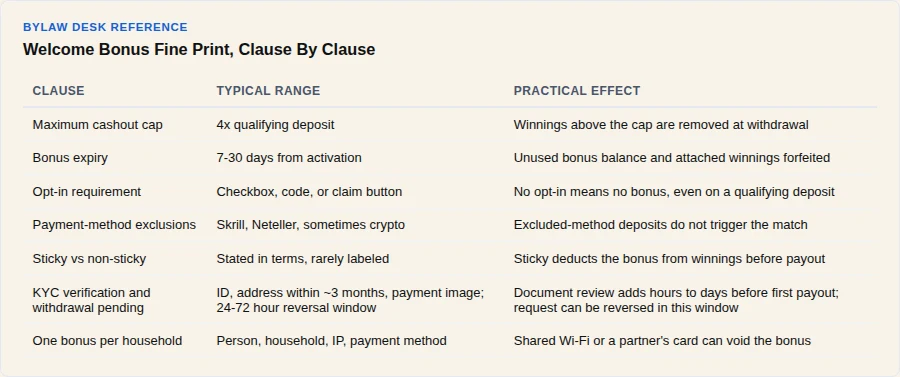
| Clause | Typical range | Practical effect |
|---|---|---|
| Maximum cashout cap | 4x qualifying deposit | Winnings above the cap are removed at withdrawal |
| Bonus expiry | 7-30 days from activation | Unused bonus balance and attached winnings forfeited |
| Opt-in requirement | Checkbox, code, or claim button | No opt-in means no bonus, even on a qualifying deposit |
| Payment-method exclusions | Skrill, Neteller, sometimes crypto | Excluded-method deposits do not trigger the match |
| Sticky vs non-sticky | Stated in terms, rarely labeled | Sticky deducts the bonus from winnings before payout |
| KYC verification and withdrawal pending | ID, address within ~3 months, payment image; 24-72 hour reversal window | Document review adds hours to days before first payout; request can be reversed in this window |
| One bonus per household | Person, household, IP, payment method | Shared Wi-Fi or a partner’s card can void the bonus |
FAQ
Does a maximum cashout cap apply to the deposit as well as the winnings?
Usually not. The cap typically applies to bonus-derived winnings, and the original deposit is returned. Some terms apply the cap to the total withdrawal instead, which reduces the amount paid below the cap figure. The clause wording decides which version applies.
Can a bonus expiry date be extended?
Rarely, and usually only at the operator’s discretion. The standard term is forfeiture at expiry with no extension. A player who cannot complete wagering within the typical expiry window should assume the bonus balance is lost on the expiry date.
If the opt-in was missed, will support apply the bonus afterward?
Sometimes, as a one-time courtesy. The terms give the operator discretion, and many exercise it in the player’s favor once. The reliable approach is to confirm the bonus is credited at signup, before play begins.
Is a non-sticky bonus always better than a sticky one?
No. A non-sticky bonus forfeited on an early withdrawal can leave a player with less than a sticky structure would have paid. The clause that matters is the one describing what happens to the bonus at the moment of withdrawal.
Does KYC delay every withdrawal, or only the first?
The document review is typically a one-time gate before the first withdrawal. The separate 24-72 hour pending period can apply to every request, and the two windows stack on the first one.
The terms page is not fine print in the sense of being hidden. It is fine print in the sense of being unread. Every clause above is meant to be disclosed somewhere in the terms, and every one of them changes what a player nets. Reading seven lines before depositing is cheaper than reading them after a withdrawal is declined. 18+.

Bylaw Desk — editorial byline