
Why Online Casinos Are Popular in Canada
§ 25.13 · Marc-André Fortin ·

Online casinos are popular in Canada for a reason that surprises most people. The growth stems from existing gamblers concentrating their play on regulated digital platforms. Statistics Canada data shows overall gambling participation has fallen over the past two decades. Ontario’s regulated iGaming market keeps setting revenue records at the same time, reaching CA$2.9 billion in the last fiscal year. Trust in licensed sites is climbing too, with 91.1% of Ontario online gamblers now using regulated platforms. That shift explains the industry’s growth.
A Shrinking Player Base, a Growing Online Market
Statistics Canada’s 2018 Canadian Community Health Survey put overall participation at well under three in four adults, with the decline uneven across age groups.
| Canadian Gambling Participation (StatCan 2018 CCHS) | |
| Group | Participation |
| All Canadians, 2002 | 76% |
| All Canadians, 2018 | 64.5% |
| Ages 45-64 (highest), 2018 | 72.3% |
| Ages 15-24 (lowest), 2018 | 43.9% |
About 18.9 million Canadians still gambled in some form that year, a smaller share than two decades earlier.
Meanwhile, Ontario’s regulated online market has grown every fiscal year since it launched.
| Ontario iGaming Revenue by Fiscal Year | ||
| Fiscal Year | Gross Revenue | Total Wagers |
| FY2022-23 | CA$1.3 billion | — |
| FY2023-24 | CA$2.2 billion | — |
| FY2024-25 | CA$2.9 billion | CA$82.7 billion |
| July 2026 (monthly record) | CA$330.4 million | CA$8.78 billion |
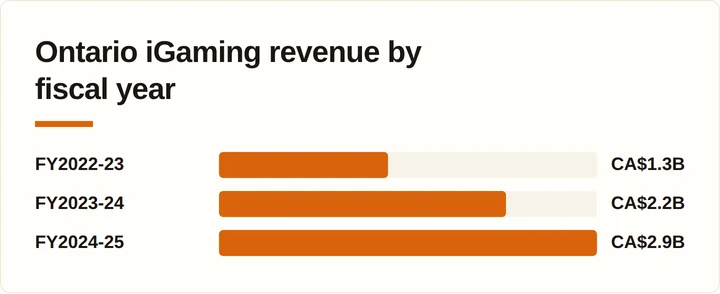
Roughly 2.6 million active player accounts drove that activity. Trade-press analysis combining Statistics Canada data with iGaming Ontario reports concluded the growth comes from deeper engagement among existing players migrating online. That table also includes July 2026’s result: a fresh monthly record, up 30.9% year-over-year, that was the second record set in three months, according to iGaming Ontario’s market data.
Convenience plays a role in that migration. Online platforms are available around the clock, and you can play from your living room without travel or dress codes. Convenience plays a role, and the bigger driver is that the players who remain in the market are spending more time and money online than they ever did in physical venues.
Game Selection and What Canadians Actually Play
Game variety gives online operators a clear edge over land-based venues. A physical casino floor has space constraints. A digital platform can host thousands of titles across every category, and operators refresh their lobbies regularly to keep regular players engaged.
Statistics Canada’s survey data shows what Canadians play when they gamble at all. Among past-year gamblers, lottery and raffle tickets were the most common at 51.8%, followed by instant lottery and online games at 33.0%. Electronic gambling machines drew 12.6%, and sports betting drew 7.9%. Casino table games followed at 7.5%, with bingo at 3.9%. Those figures span every kind of gambling activity, online and offline alike, which is why they work as a baseline.
Among Canadian online casino players today, preferences skew toward slots with modern mechanics such as Megaways, cascading reels, expanding wilds, and progressive jackpots. Live-dealer tables are the other major draw, with blackjack attracting the largest audience, followed by roulette, where Lightning variants are notably popular, and then baccarat. Consumer gaming press coverage of the Canadian market consistently highlights these categories as the main drivers of engagement.
The gap between what land-based venues can offer and what online platforms deliver is widest in slots. A physical casino might have a few hundred machines. An online lobby can offer thousands of titles with different mechanics, themes, and volatility profiles, which means you can switch from a low-stakes classic to a high-volatility progressive without leaving your seat.
Bonuses and Promotions, Kept Qualitative
Bonuses are how online operators compete for your attention in a crowded market. The structure is consistent across licensed Canadian platforms. A welcome offer typically matches your first deposit and adds free spins, then reload bonuses and cashback offers appear as you continue playing. VIP tiers reward consistent play with higher limits, faster withdrawals, and dedicated account managers.
These offers matter because they reduce the cost of trying something new. A welcome match effectively doubles your starting bankroll, which lets you explore different game types without risking as much of your own money. Free spins attached to new slot releases give you a no-cost way to test a game before committing real funds.
You should read the terms attached to any bonus before you claim it. Wagering requirements, game eligibility, and withdrawal limits vary by operator, and a bonus that looks generous on the surface can carry conditions that make it less valuable in practice. The appeal of bonuses is straightforward. They give you more play for your deposit, and in a market where operators are competing for your loyalty, the offers keep improving.
Privacy and Playing on Your Own Terms
Online play removes the social pressure that some people feel in a physical casino. When you play from home, nobody watches you sit down at a table, nobody sees how much you buy in for, and nobody reacts to your wins or losses. For many players, that privacy is the difference between gambling occasionally and not gambling at all.
You also control the pace. A live dealer runs a table on a fixed rhythm, but when you play online, you can take your time, pause between rounds, or step away entirely. Digital platforms let you set your own limits on deposits and losses, and responsible-gambling tools are built into licensed sites by design.
The comfort factor extends to game selection. Trying an unfamiliar game type in a busy casino can feel exposed. Online, you can open a title, read the rules, play in demo mode if the operator offers it, and only then decide whether to wager real money. That low-pressure environment is a genuine advantage of digital play.

Why Players Increasingly Trust Regulated Sites
iGaming Ontario and the AGCO commissioned a channelization study from Ipsos. Fourth-year results, published May 21, 2026, show a clear shift toward licensed platforms.
| Ontario Online Gambling Channelization (Ipsos Study, Year 4) | ||
| Year | Regulated Sites | Unregulated Sites |
| Previous year | 83.7% | 16.3% |
| Year 4 (2026) | 91.1% | 8.9% |
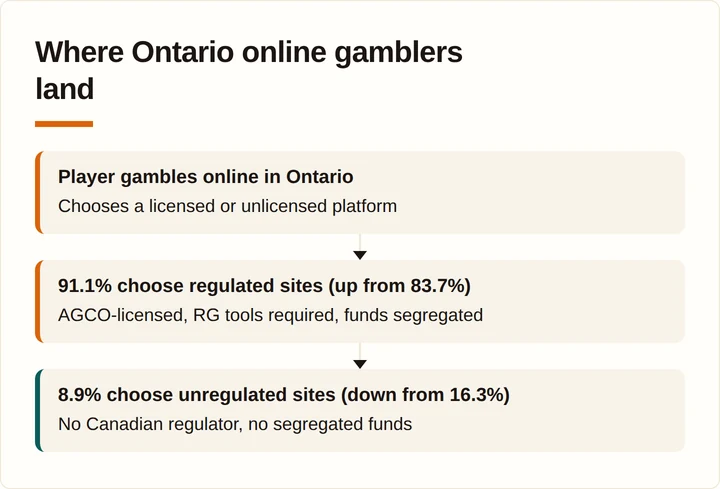
That same channelization shift reflects a gain of 7.4 percentage points in regulated-site usage over the prior year. Unregulated-site usage fell by the same margin.
That shift is the direct result of mandatory rules. Licensed Ontario operators must implement responsible-gambling tools including deposit and loss limits, time-outs, and self-exclusion. They must keep player funds segregated from operating capital, so your balance is protected even if the operator runs into financial trouble. And they must undergo regular independent audits of game fairness by AGCO-registered testing labs, including GLI, iTech Labs, BMM, eCOGRA, and Gaming Associates Europe.
For you as a player, those requirements translate into concrete protections. The games are tested for fairness, your money is held separately from the operator’s funds, and the tools to control your play are mandatory. When that high share of online gamblers in Ontario choose regulated sites, they are voting with their wallets for those protections.
The contrast with unregulated offshore sites is stark. Those platforms answer to no Canadian regulator, offer no segregated funds, and provide no independent verification of game fairness. The channelization data suggests Canadian players have noticed the difference.
FAQ
Why has gambling popularity shifted from land-based to online casinos?
Overall gambling participation in Canada has declined for two decades. The growth is in online play specifically. Ontario’s regulated iGaming market grew from CA$1.3 billion in FY2022-23 to CA$2.9 billion in FY2024-25. Existing gamblers are migrating online for convenience, game variety, and privacy.
Are online casinos safe for Canadian players?
Licensed Ontario operators must follow strict rules. Those rules include responsible-gambling tools, segregated player funds, and independent game-fairness audits by AGCO-registered labs. The Ipsos channelization study found that 91.1% of Ontario online gamblers now use regulated sites, up from 83.7% the previous year, which suggests players increasingly trust licensed platforms over unregulated alternatives.
Which age group gambles most in Canada?
Canadians aged 45 to 64 have the highest gambling participation at 72.3%, according to Statistics Canada’s 2018 survey. The lowest participation is among the youngest adult bracket (43.9% participation). That decline has been uneven across age groups.

Bylaw Desk — editorial byline