
Who Regulates Online Gambling in Canada? Federal Rules, Provincial Markets
§ 25.07 · Marc-André Fortin ·

Yes, online gambling is legal in Canada because the Criminal Code gives provinces the power to conduct and manage lottery schemes, which legally covers casino games and online betting, and each province decides how to use that authority. For most of the past decade, that meant one government-run platform per province. Then Ontario opened a competitive market in 2022, and Alberta followed in July 2026, giving Canadian players two provinces where private operators can hold licences. If you’re comparing options across these newly opened markets, is online gambling legal in Canada is worth understanding before you pick a site.
The Legal Foundation: Section 207 and the Provincial Handoff
Section 207 is the key provision of the Criminal Code. It creates an exception to the general prohibition on gaming and betting, letting provinces “conduct and manage” lottery schemes within their borders. The section’s own definition of a lottery scheme extends to casino games and online gaming, which is the legal hook every provincial platform hangs on.
That arrangement dates to 1985. Amendments to the Criminal Code, following a federal-provincial agreement, gave provinces exclusive control over gaming in their territory. The federal government stepped back from the field in exchange for payments to Ottawa. Provinces hold the real power over what you can play and who can offer it, within the criminal-law boundaries Ottawa sets.
Regulatory Bodies by Province
Each province has its own regulator, and the names matter because they tell you who to complain to if something goes wrong.
- Ontario: Alcohol and Gaming Commission of Ontario (AGCO) registers and regulates operators; iGaming Ontario (iGO) handles the commercial side.
- Alberta: Alberta Gaming, Liquor and Cannabis (AGLC) registers and regulates operators; the Alberta iGaming Corporation (AiGC) is the new conduct-and-manage agency.
- British Columbia: BCLC runs PlayNow.com, the single provincial platform.
- Quebec: RACJ licenses Loto-Québec, which operates Espacejeux.
- Manitoba: Manitoba Liquor and Lotteries operates PlayNow.com in that province.
- Saskatchewan: Saskatchewan Indian Gaming Authority (SIGA) runs PlayNow.com.
- Atlantic provinces: ALC in New Brunswick, Nova Scotia and Prince Edward Island; Newfoundland and Labrador uses its own arrangement.
The two-agency model in Ontario and Alberta is the outlier. Everywhere else, one government body both regulates and operates.
Ontario and Alberta: Canada’s Two Competitive Markets
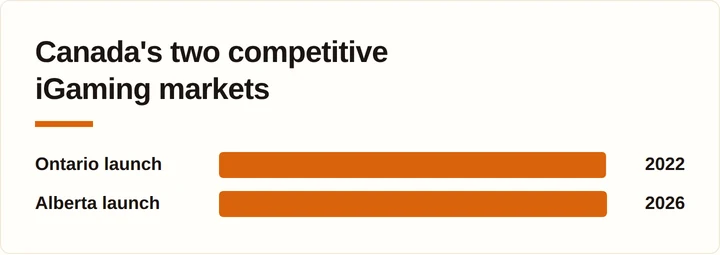
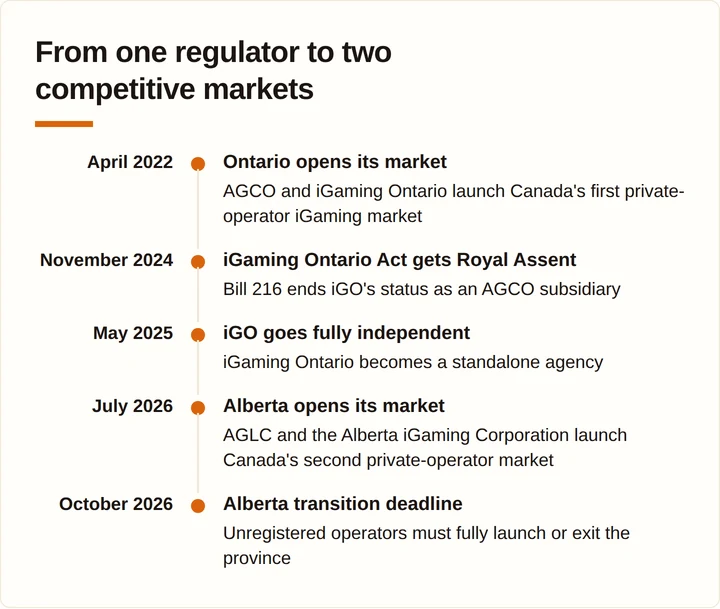
Ontario was first. On 4 April 2022, it opened its regulated private-operator iGaming market, run jointly by AGCO as registrar and iGaming Ontario as the commercial conduct-and-manage agency. At the time, iGO was a subsidiary of AGCO. That changed when Bill 216, the iGaming Ontario Act 2024, received Royal Assent on 6 November 2024. Since 12 May 2025, iGO has been a fully independent standalone agency.
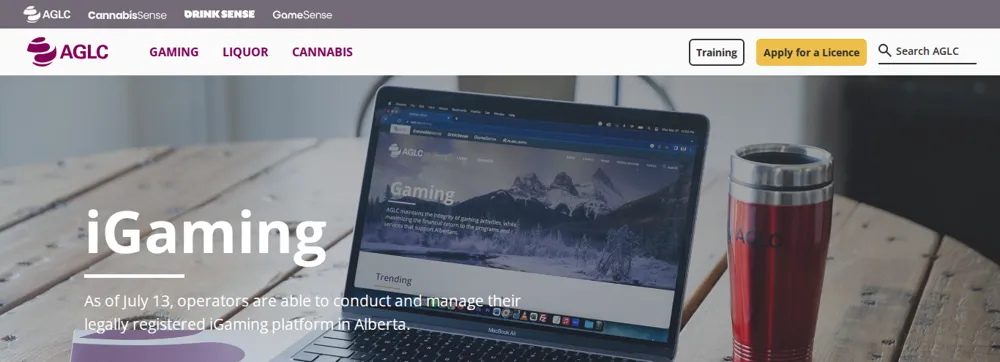
Alberta followed the same playbook. On 13 July 2026, it launched Canada’s second regulated private-operator market for iGaming and sports betting. The structure mirrors Ontario: AGLC registers and regulates operators, while the Alberta iGaming Corporation, created under the iGaming Alberta Act, acts as the commercial conduct-and-manage agency. Operators that hadn’t registered by launch had until 13 October of that year to fully launch on the regulated market or exit the province.
| Province | Regulator | Conduct-and-manage body | Launch date |
| Ontario | AGCO | iGaming Ontario | 4 April 2022 |
| Alberta | AGLC | Alberta iGaming Corporation | 13 July 2026 |
In both provinces, licensed private operators compete for your business. That means more choice in games and promotions than you get from a single government platform. It also means the regulator’s job is oversight of operators, who run the actual platforms, so there’s a clearer separation between the referee and the players.
How the Other Provinces Run Gambling
Outside Ontario and Alberta, the model is mostly government-run monopoly. British Columbia, Manitoba and Saskatchewan each operate a single platform under their respective provincial bodies. If you live in one of those provinces, the provincial site is the only legal option, and that’s by design.
Quebec sits in a hybrid position. The RACJ licenses Espacejeux, the single provincial platform operated by Loto-Québec. Quebec technically allows access to offshore sites, which creates a de facto grey market for residents. That’s similar to most provinces outside Ontario and Alberta, where offshore operators serve players without provincial licences, and the province tolerates it.
The remaining provinces are still deciding. None has announced a move toward a competitive private-operator market, and there’s no indication any will follow Ontario and Alberta soon. For now, the two-market system is the Canadian model, and the rest of the country watches to see how it plays out.
Age Limits and ID Checks
The legal gambling age varies by province. It’s 18 in Alberta, Manitoba and Quebec. It’s 19 in Ontario, British Columbia, Saskatchewan, New Brunswick, Nova Scotia, Newfoundland and Labrador, and Prince Edward Island.
Provincial platforms use geolocation to confirm you’re physically within provincial borders before you play. That’s not optional friction; it’s how provinces enforce their exclusive jurisdiction. If you cross into another province and try to log in, the platform should detect your location and block play until you’re back.
ID checks go beyond age. FINTRAC, Canada’s financial intelligence unit, requires casinos including online operators serving Canadian players to keep client identification records and report suspicious transactions. That means a licensed site will ask for government-issued ID when you register or before your first withdrawal, and it will file reports on transactions that look unusual. It’s anti-money-laundering compliance.
Offshore Sites: Legal Grey Area, Not a Crime
Using an offshore site carries no criminal penalty for the player in Canada. The Criminal Code prohibition targets unauthorized operators. If you deposit at an internationally licensed site that doesn’t hold a provincial licence, you remain within the law, even though the operator may be operating outside it.
That’s the grey area. You won’t face criminal charges for playing at an offshore site. You also lose the protections that come with a regulated provincial market. No AGCO or AGLC oversight means no complaint process, no guarantee of fair play, and no certainty your winnings will be paid. The regulated markets exist partly to give you those protections, and the tradeoff is that you play only with licensed operators.
FAQ
Is online gambling legal in Canada?
Yes. Section 207 of the Criminal Code lets provinces conduct and manage lottery schemes, which covers online casino games and betting. Each province decides how to use that authority, which is why rules differ across the country.
What’s the difference between Ontario/Alberta and other provinces?
Ontario and Alberta have competitive markets where private operators hold licences from the provincial regulator. Other provinces run a single government platform, so your only legal option is the provincial site.
Is it legal to play at offshore sites?
Playing at an offshore site carries no criminal penalty. The Criminal Code targets unauthorized operators. You lose regulatory protections. You also face no criminal liability.
Are gambling winnings taxable?
For most recreational players, no. The CRA treats winnings as windfall gains. See how gambling winnings are taxed in Canada for the full breakdown, including when that changes for professional players.
—
*Gambling involves risk. Play responsibly. If you or someone you know needs help, contact your provincial support line. Must be of legal age in your province to gamble.*

Bylaw Desk — editorial byline