
Player Rights and Protections at Licensed Canadian Online Casinos
§ 25.10 · Marc-André Fortin ·

If you play at a licensed Canadian online casino, whether provincially regulated or properly licensed offshore, you get real and enforceable protections. Those protections include certified fair games, identity and age verification, responsible-gambling tools, and a complaint path that leads to a regulator with actual enforcement power. The Criminal Code targets unlicensed operators.
Player Rights Under Canadian Law
Your core rights at a regulated Canadian online casino come down to five things. You get fair and certified games, transparent terms and conditions, protection of your personal data, timely withdrawals, and access to a dispute process when something goes wrong.
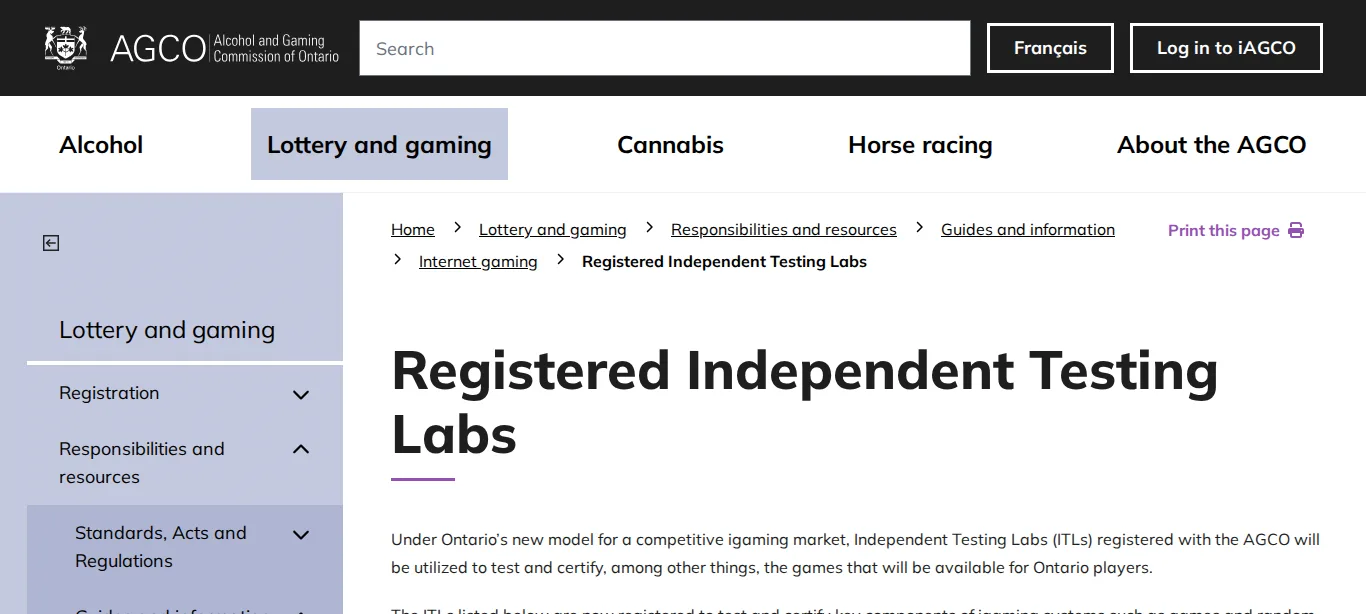
The fairness guarantee matters most. In Ontario, every game and random number generator (RNG) supplied to regulated operators must be certified against the Registrar’s Standards for Internet Gaming by an AGCO-registered Independent Testing Laboratory (ITL). The current registered labs are GLI (Gaming Laboratories International), iTech Labs, BMM North America, eCOGRA, and Gaming Associates Europe. These labs test that slot payouts match published return-to-player percentages and that RNGs produce genuinely random results.
When a game displays a certified RNG seal, an independent third party has verified it. That is a meaningful check on the operator’s incentive to tilt the house edge.
Transparent terms are the second pillar. Licensed operators must publish clear rules on bonuses, wagering requirements, and withdrawal limits. Data privacy protections come from provincial privacy law and the operator’s own obligations under its licence. Timely withdrawals are a licence condition. Dispute access is your statutory path when an operator fails you on any of the above.
Age Verification and Identity Requirements
The legal gambling age in Canada is 18 in Alberta, Manitoba, and Quebec. It is 19 in Ontario, British Columbia, Saskatchewan, New Brunswick, Nova Scotia, Newfoundland and Labrador, and Prince Edward Island. Provincial platforms use geolocation to confirm you are physically inside provincial borders when you play.
Before your first deposit, a licensed operator will run a know-your-customer (KYC) check. Expect to provide government-issued ID, proof of address, and sometimes a selfie for facial matching. This process verifies that you are of legal age and that you are not on a self-exclusion list. Behind the scenes, FINTRAC (the Financial Transactions and Reports Analysis Centre of Canada) requires casinos, including online operators serving Canadian players, to keep client identification records and report suspicious transactions as part of anti-money-laundering compliance. Your KYC documents serve dual duty. They protect you from underage-play problems and they feed Canada’s financial-crime monitoring system.
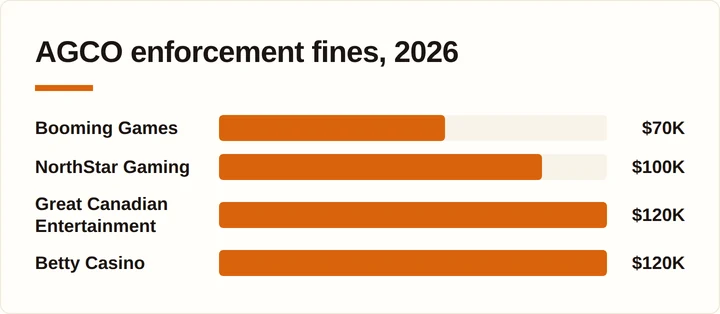
This year’s enforcement record shows why these checks matter. Betty Casino was fined $120,000 for age-verification and player-control failures that allowed under-19 signups. That fine is a concrete example of the regulator enforcing the rules you rely on.
Responsible Gambling Protections
The biggest 2026 development in Canadian player protection is BetGuard, iGaming Ontario’s Centralized Self-Exclusion (CSE) program.
Before BetGuard, excluding yourself meant contacting each operator separately. That process could fail if you played at multiple sites. Now, one registration excludes you from every regulated Ontario iGaming site.
You choose your exclusion period. The options are six months, one year, or five years. During that time, licensed operators must block your access and stop sending you marketing. This replaces the old patchwork approach with a single, enforceable registry.
Ontario operators also carry qualitative responsible-gambling obligations. They must hold RG Check accreditation, spend on responsible-gambling marketing, and share anonymized player data for research. The actual spending requirement is qualitative rather than a published percentage of revenue.
If you are considering self-exclusion, know that the tools work across the regulated market. That is the protection BetGuard delivers.
Dispute Resolution Process
When something goes wrong, such as a disputed withdrawal or a bonus term you believe was misapplied, the path is structured.
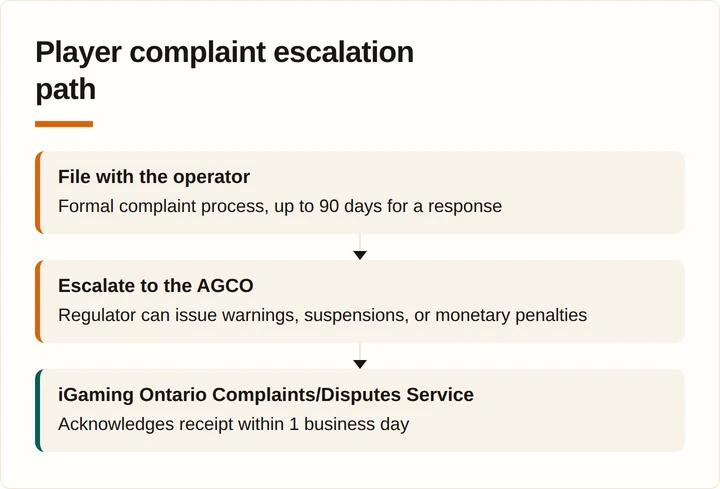
- File with the operator first. Licensed operators must run a formal complaints process. The operator can take up to 90 days to respond.
- Escalate to the AGCO. If the operator’s answer is unsatisfactory or you believe the site broke the rules, file a complaint with the Alcohol and Gaming Commission of Ontario. The AGCO can issue warnings, suspensions, or monetary penalties.
- iGaming Ontario’s Complaints/Disputes Service runs alongside the AGCO path and acknowledges receipt within one business day.
That enforcement record shows the penalties are real. Booming Games (Malta) was fined CA$70,000 for a prohibited auto-play feature in its Ontario slots. Great Canadian Entertainment was fined $120,000 for unauthorized gaming software. NorthStar Gaming was fined $100,000 over anti-money-laundering failures. These are monetary penalties that hit the operator’s bottom line.
Keep records of your deposits, withdrawals, and correspondence with the operator. If you escalate to the AGCO, you will need to document the timeline.
Legal Protections for Offshore Casino Play
The table below compares the key differences between provincially regulated casinos and offshore sites that serve Canadian players. It covers legal status, oversight, dispute options, and consumer protections.
| Aspect | Provincial Casinos | Offshore Casinos |
| Legal status | Fully licensed under provincial law | Not prohibited for players, but not licensed in Canada |
| Regulatory oversight | Provincial regulator (e.g., AGCO, iGO) | Foreign jurisdiction (e.g., Malta, Gibraltar) |
| Dispute resolution | Formal complaint to provincial regulator | Variable; depends on foreign licence terms |
| Consumer protections | Comprehensive (certified games, KYC, RG tools, enforcement) | Variable; often weaker than provincial standards |
The Criminal Code does not criminalize individual Canadian players who use offshore or internationally licensed gambling sites. The prohibition targets unauthorized operators. If you choose to play at a Malta- or Gibraltar-licensed site, you are not breaking the law.
What you give up is oversight. A provincially regulated platform answers to the AGCO or its provincial equivalent, which can fine, suspend, or revoke licences. An offshore platform answers to its home regulator, and your recourse if something goes wrong depends on that foreign jurisdiction’s rules. The games may be certified by the same independent labs, but the enforcement chain is longer and less familiar.
FAQ
What can I do if a licensed casino refuses to pay my winnings?
Follow the formal complaint path. File with the operator first, since they have up to 90 days to respond. Then escalate to the AGCO if unresolved. The AGCO can issue penalties that make non-payment an expensive choice for the operator. Document everything.
Can I be prosecuted for playing at an offshore casino?
No. The Criminal Code targets unauthorized operators. The risk with offshore play is reduced consumer protection, since an offshore dispute may leave you with fewer options than a provincially regulated one.
Are my funds protected if an online casino goes bankrupt?
Provincially regulated operators must segregate player funds from operating capital, which offers some protection in insolvency. Offshore protection depends on the jurisdiction’s rules. Gambling winnings are generally treated as windfall gains by the CRA, a topic covered in more depth on how gambling winnings are taxed in Canada.
If you or someone you know is struggling with gambling, help is available. Contact your provincial gambling helpline or visit ConnexOntario (Ontario) for free, confidential support.

Bylaw Desk — editorial byline